
Could Your Business Keep Operating During a Power Cut?
For many businesses, electricity is essential to everyday operations. From computers and payment terminals to refrigeration, communications and security systems, even a short interruption to the power supply can cause significant disruption.
A power cut might mean temporarily closing your premises, losing access to important systems, interrupting production or being unable to serve customers.
While the UK’s electricity network is generally reliable, unexpected outages can still occur because of severe weather, equipment failures and damage to electrical infrastructure.
So, what would happen if your business lost power during its busiest period?
And could commercial battery backup help protect your operations?
How Could a Power Cut Affect Your Business?
The impact of an electricity outage depends on the nature of the business, the equipment it relies upon and how long the interruption lasts.
For some organisations, losing power may be an inconvenience. For others, even a short outage could have serious operational or financial consequences.
Potential problems include:
- Lost revenue: Retailers, hospitality businesses and other customer-facing organisations may be unable to process transactions or continue trading.
- IT disruption: Computers, servers, networking equipment and cloud-connected systems may become unavailable.
- Refrigeration losses: Food businesses and other organisations relying on temperature-controlled storage could face product losses if an outage continues.
- Interrupted production: Machinery and automated processes may stop unexpectedly, potentially causing downtime or wasted materials.
- Communication failures: Internet connections, telephone systems and other communications equipment may be affected.
- Security concerns: Access control, CCTV and alarm systems may require their own backup arrangements to remain operational.
The consequences can extend beyond the duration of the power cut itself.
Restarting equipment, checking systems and restoring normal operations may take additional time.
For this reason, businesses should consider which electrical services are essential and how they would respond if the grid supply became unavailable.
What Is Commercial Battery Backup?
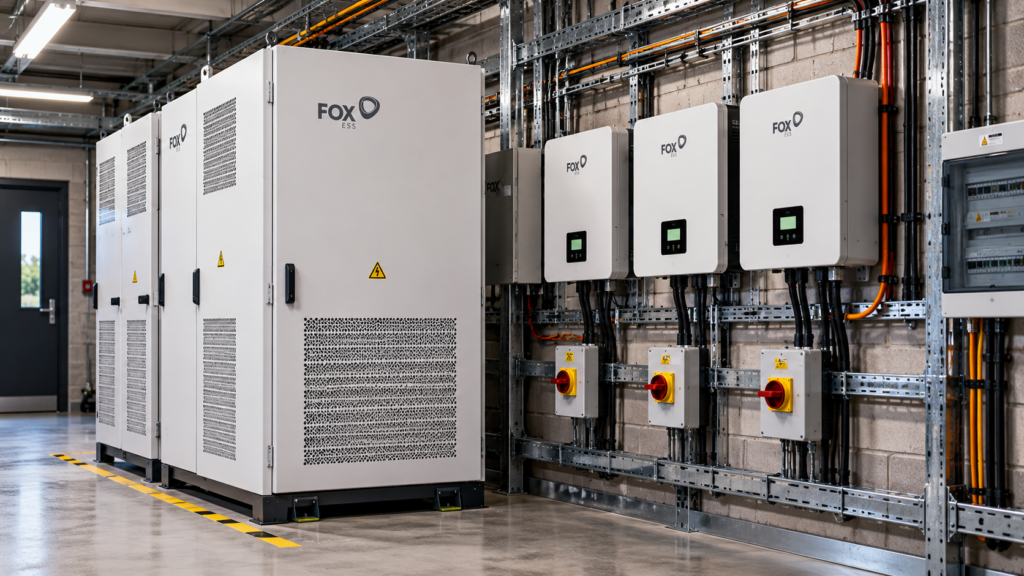
Commercial battery energy storage systems, often referred to as BESS, store electricity for later use.
During normal operation, stored electricity may be used to manage energy consumption, support solar generation or reduce the amount of electricity purchased during expensive tariff periods.
However, not every commercial battery storage system can provide emergency power during a grid outage.
Many conventional grid-connected systems automatically stop supplying electricity when the network fails.
To operate during a power cut, a commercial battery installation must include suitable backup functionality, compatible inverter equipment and electrical arrangements that safely isolate the relevant installation from the grid.
Depending on the design, the system may provide electricity to selected essential circuits or a larger proportion of the business premises.
The available power and backup duration depend on the equipment installed and the electrical demands of the business.
What Equipment Could Commercial Battery Backup Power?
The answer depends on the type of business and the system’s available capacity and output.
A suitably designed backup installation might support selected equipment such as:
- Computers, networking equipment and communications systems.
- Payment terminals and point-of-sale equipment.
- Selected lighting circuits.
- Security and access control systems.
- Refrigeration and temperature-monitoring equipment.
- Essential office equipment.
- Certain control systems or other operationally important electrical loads.
However, equipment with high electrical demand may require significantly larger systems.
Commercial refrigeration, heating and cooling equipment, machinery and electric motors can also have substantial starting currents, which must be considered alongside their normal running power.
A battery system must be capable of supplying the required loads without exceeding its operating limits.
The objective is not necessarily to power everything. It is to identify which operations need to continue and design a suitable backup arrangement around them.
Essential-Load Backup vs Whole-Site Backup
As with domestic installations, commercial battery backup can be designed around different levels of electrical coverage.
Essential-Load Backup
An essential-load system supplies electricity to selected circuits or equipment considered important for business continuity.
For example, a small office might prioritise its internet connection, networking equipment, a limited number of workstations and essential lighting.
A retailer might prioritise payment systems, selected lighting and security equipment.
By limiting the number of supported loads, a business may be able to reduce the required inverter output and extend the available backup duration.
Whole-Site Backup
A whole-site backup system is intended to make an alternative electricity supply available to a wider electrical installation.
However, this does not mean every piece of equipment can operate simultaneously.
Commercial premises may contain large electrical loads, three-phase machinery, heating and cooling systems or equipment with substantial starting currents.
The backup system must be designed to accommodate the intended demand, including any requirements for load shedding, staged equipment starting or operational restrictions.
Whole-site backup can therefore require considerably more detailed assessment and potentially much larger equipment than an essential-load installation.
Battery Backup, UPS or Generator: What’s the Difference?
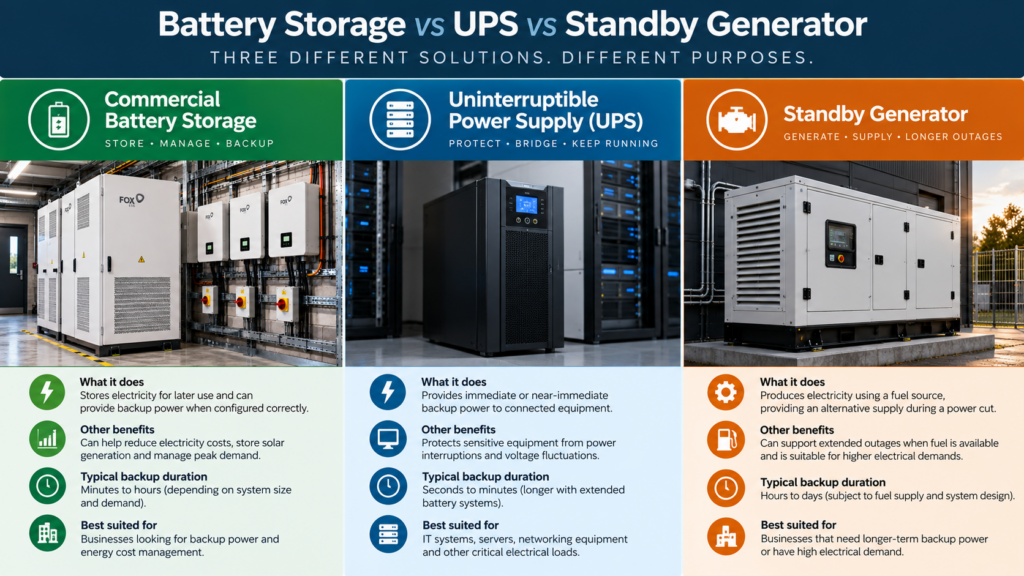
Businesses considering emergency power may encounter several different technologies.
Although they can serve similar purposes, commercial battery storage, uninterruptible power supplies and standby generators are not interchangeable.
Commercial Battery Storage
A backup-capable battery storage system uses stored electrical energy to supply suitable loads when the normal grid supply is unavailable.
Depending on its configuration, it may also provide benefits during everyday operation, such as storing solar electricity or taking advantage of time-of-use tariffs.
Its main limitations include finite stored energy, maximum inverter output and the need for compatible backup switching arrangements.
Uninterruptible Power Supply (UPS)
A UPS is designed to protect connected equipment against interruptions to the electricity supply.
UPS systems are commonly used for servers, networking equipment, critical control systems and other sensitive electrical loads.
Depending on the UPS design, power can be maintained without a perceptible interruption to connected equipment.
A UPS may provide enough time for equipment to shut down safely or for another power source to become available.
Its runtime depends on the equipment and battery capacity.
Standby Generator
A standby generator produces electricity using an engine-driven power source, typically fuelled by diesel, gas or another suitable fuel.
Generators can provide an alternative supply during extended outages, subject to fuel availability, equipment capacity and maintenance.
They may also require suitable changeover equipment and arrangements for safe connection to the electrical installation.
Could a Business Need More Than One?
Yes.
Some businesses use a combination of technologies.
For example, a UPS might maintain uninterrupted electricity to essential IT equipment while a generator or battery system becomes available to support wider electrical loads.
The most suitable arrangement depends on how quickly backup power is required, how long it must last and which equipment needs protection.
How Long Could a Commercial Battery Keep a Business Running?
Backup duration depends on the amount of usable stored energy and the electrical demand of the equipment being supplied.
Battery capacity is measured in kilowatt-hours (kWh), while electrical power is measured in kilowatts (kW).
For example, consider a commercial battery system with 50 kWh of usable stored energy.
If the supported equipment has an average demand of 5 kW, the theoretical runtime would be:
50 kWh ÷ 5 kW = 10 hours.
If the average demand increases to 10 kW, the theoretical runtime falls to:
50 kWh ÷ 10 kW = 5 hours.
These are simplified examples, not guaranteed backup durations.
Actual performance will depend on inverter efficiency, standby consumption, battery operating limits, the state of charge when the outage begins and variations in electrical demand.
The inverter must also be rated to supply the required power, including relevant starting loads.
For businesses needing extended backup, additional battery capacity or an alternative means of generating electricity may be necessary.
Can Commercial Battery Storage Work with Three-Phase Electricity?
Yes. Commercial battery storage systems are available for three-phase electrical installations.
Three-phase supplies are commonly found in commercial and industrial premises where electrical demand is greater or where equipment requires three-phase power.
Suitable commercial battery systems can be designed to work with these supplies, but additional considerations may include:
- Electrical demand on each phase.
- The balance of single-phase and three-phase loads.
- Motor starting currents and other short-duration power demands.
- The inverter’s available backup output.
- Existing electrical distribution and protective equipment.
- Grid isolation and changeover arrangements.
- Battery capacity and required backup duration.
For example, some commercial three-phase hybrid inverters, including models in the Fox ESS H3 Pro range, incorporate emergency power supply functionality.
However, the presence of an EPS feature does not automatically establish that a particular inverter is suitable for an entire commercial premises.
Equipment compatibility, load requirements and the complete electrical design must be assessed before specifying a backup installation.
Can Commercial Battery Storage Also Reduce Electricity Costs?
Potentially, yes.
Commercial battery storage can provide benefits during normal operation as well as supporting emergency preparedness when suitable backup functionality is included.
Off-Peak Electricity Storage
Some businesses have electricity tariffs with different rates at different times.
A compatible battery system may be able to charge when electricity is cheaper and discharge during more expensive periods.
The financial benefit depends on the tariff structure, consumption patterns, battery efficiency and installation costs.
Solar Energy Storage
Businesses with solar PV may be able to store some of the electricity generated during the day and use it later.
This can help increase the amount of solar electricity consumed on-site.
However, the ability to use solar generation during a grid outage depends on the specific system design and its off-grid operating capabilities.
Peak Demand Management
Some commercial battery systems can also be configured to reduce the amount of power drawn from the grid during periods of high demand.
This may help manage certain electricity charges where the business’s tariff and metering arrangements make such savings possible.
These benefits should be assessed against the cost of the system, ongoing operating requirements and the business’s actual electricity consumption.
What Should Businesses Consider Before Installing Battery Backup?
Before investing in a backup system, it’s important to establish what the business needs to achieve.
1. Identify Essential Equipment
Which systems must continue operating during an outage?
Consider whether the priority is maintaining full operations, protecting valuable stock, preserving data or allowing equipment to shut down safely.
2. Establish Acceptable Downtime
Can the business tolerate a brief interruption while a backup supply activates?
If not, equipment requiring uninterrupted electricity may need a dedicated UPS or another appropriately designed solution.
3. Assess Electrical Demand
The system must be sized around the actual loads that require backup, including their starting currents and simultaneous operation.
4. Determine the Required Backup Duration
Would a short period of emergency power be sufficient, or does the business need to continue operating for several hours?
Longer backup periods generally require greater usable energy capacity or a means of replenishing the stored electricity.
5. Review the Existing Electrical Installation
The type of electricity supply, distribution arrangements, available installation space and existing electrical equipment can all influence the design.
6. Consider Normal-Day Energy Benefits
If battery storage could also help manage electricity costs, this may influence the preferred system configuration and operating strategy.
For example, a system intended to provide emergency backup may need to maintain a minimum battery reserve rather than using all its stored energy for everyday tariff savings.
What Affects the Cost of Commercial Battery Backup?
Commercial battery backup systems vary considerably in size, complexity and specification.
The overall cost may depend on:
- Required inverter output and battery capacity.
- Essential-load or whole-site backup requirements.
- Single-phase or three-phase electrical arrangements.
- Changeover, isolation and protective equipment.
- Existing distribution board and cabling arrangements.
- Integration with solar PV, generators or UPS equipment.
- Monitoring, controls and load-management requirements.
- Installation, commissioning and ongoing maintenance.
A site-specific technical assessment is therefore necessary before establishing the appropriate equipment and likely project cost.
Is Commercial Battery Backup Worth Considering?
For businesses that rely heavily on electricity, understanding the potential consequences of a power cut is an important part of operational planning.
A suitably designed battery backup system may help maintain selected electrical services, protect essential operations or reduce disruption during an outage.
When combined with appropriate energy management, commercial battery storage may also offer opportunities to make better use of solar generation and time-of-use electricity tariffs.
However, no single solution is suitable for every business.
The right approach depends on electrical demand, acceptable downtime, required backup duration and the consequences of losing power.
Discuss Commercial Battery Storage with Starkey Electrical
Whether you’re exploring emergency power for essential business equipment, considering commercial battery storage or investigating ways to manage electricity costs, the starting point is understanding your site’s requirements.
Starkey Electrical can discuss your objectives and explore potential commercial battery storage and backup options, subject to technical assessment, equipment suitability and confirmation of the appropriate design and installation arrangements.
Contact Starkey Electrical to discuss your business’s electricity requirements and explore the available options.
Interested in domestic battery backup? Read our related articles: