
Essential Circuits vs Whole-Home Battery Backup: What’s the Difference?
When the electricity supply fails, a home battery with emergency backup functionality can help keep important appliances and electrical circuits operating.
But not all battery backup systems work in the same way.
Some installations are designed to power a small number of essential circuits, while others can supply the wider household electrical installation during a power cut.
Understanding the difference between essential-circuit backup and whole-home battery backup is an important step when choosing a system for your property.
So, how do these options compare, what can they realistically power, and which might be most suitable for your home?
What Is Essential-Circuit Battery Backup?
Essential-circuit backup, sometimes called partial-home backup, is designed to provide electricity to a selected group of circuits when the normal grid supply becomes unavailable.
Rather than attempting to power everything in the property, the system prioritises equipment that the homeowner considers most important.
Depending on the installation, these circuits might include:
- Selected lighting circuits.
- Fridges and freezers.
- Internet routers and communication equipment.
- Heating controls and circulation pumps.
- Selected sockets for charging phones, laptops and other devices.
- Other equipment identified during the system design.
The backed-up circuits are connected through suitable electrical arrangements that allow them to receive power from a compatible battery inverter during an outage.
When the grid supply fails, the backup system safely separates the relevant installation from the electricity network before supplying stored energy.
The exact switching process and transfer time depend on the equipment installed.
Advantages of Essential-Circuit Backup
One of the main benefits of this approach is that it concentrates the available battery energy on a smaller number of loads.
By excluding high-consumption appliances, homeowners may be able to extend the time their essential equipment remains operational.
For example, keeping a fridge, router and selected lights running will generally require much less electricity than operating an electric oven, shower or immersion heater.
Essential-circuit backup can therefore be a practical option for households whose main priority is maintaining basic services during a temporary power cut.
Limitations of Essential-Circuit Backup
Only the circuits included in the backup arrangement will receive electricity during an outage.
Other circuits will remain without power until the grid supply returns.
The installation may also require alterations to the property’s existing electrical distribution arrangements, depending on the number and location of the circuits being backed up.
What Is Whole-Home Battery Backup?
Whole-home battery backup is designed to supply the household’s electrical installation from a compatible battery storage system when grid electricity becomes unavailable.
Rather than separating a small number of essential circuits, a whole-home configuration can make backup electricity available across the property.
This is achieved using appropriately designed switching and isolation equipment, together with a compatible inverter and battery.
When the grid fails, the system disconnects the property from the electricity network and changes over to the backup supply.
Once the grid returns, the system can switch back to normal operation.
Does Whole-Home Backup Mean Everything Will Keep Working?
Not necessarily.
Whole-home backup does not mean unlimited electricity.
Although power may be available throughout the property, the amount that can be used at any one time is restricted by the inverter’s output capability and the battery system’s operating limits.
For example, a household might be able to operate lighting, refrigeration, televisions and other modest electrical loads without difficulty.
However, switching on several high-demand appliances simultaneously could exceed the backup system’s available output.
Equipment such as electric showers, ovens, immersion heaters and EV chargers may need to be avoided or controlled during an outage.
A whole-home installation must therefore be designed around the property’s electrical demand, with suitable load management or restrictions where necessary.
Whole-Home Backup in Practice: Fox ESS
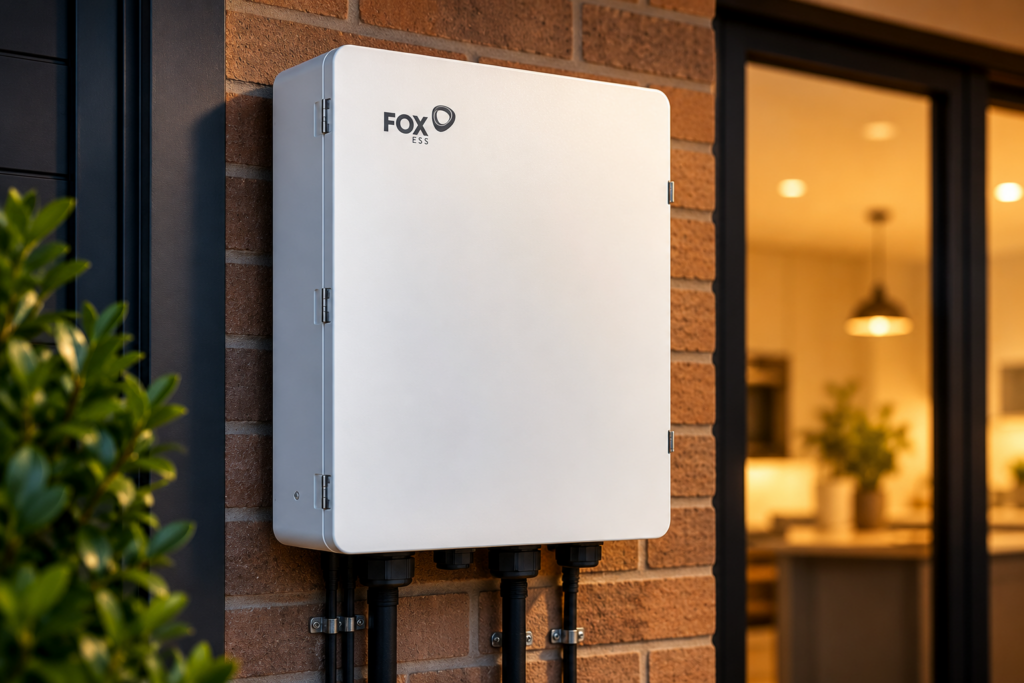
Modern battery storage manufacturers offer equipment specifically designed to simplify whole-home backup installations.
One example is the Fox ESS EPS-BOX-SP Power Backup Gateway.
This single-phase gateway is designed to work with compatible Fox ESS inverter and battery storage systems, providing automatic switching between normal grid operation and emergency backup operation.
During a power cut, the gateway isolates the property from the grid and allows the compatible inverter to supply electricity from the available battery storage.
When the electricity network is restored, the system automatically returns to normal grid operation.
Fox ESS specifies a typical changeover time of approximately two to three seconds.
This means there will generally be a brief interruption to the electricity supply during switching.
The gateway supports a maximum grid input current of 100 A, but this should not be confused with the amount of backup electricity the inverter and battery can provide.
The available backup power remains dependent on the specific inverter, battery configuration and electrical loads.
The Fox ESS gateway illustrates how whole-home backup can be achieved, although compatibility, installation requirements and suitability must be confirmed for each property.
Essential-Circuit Backup vs Whole-Home Backup: A Comparison
Both approaches can provide useful protection against temporary electricity interruptions, but they offer different levels of coverage.
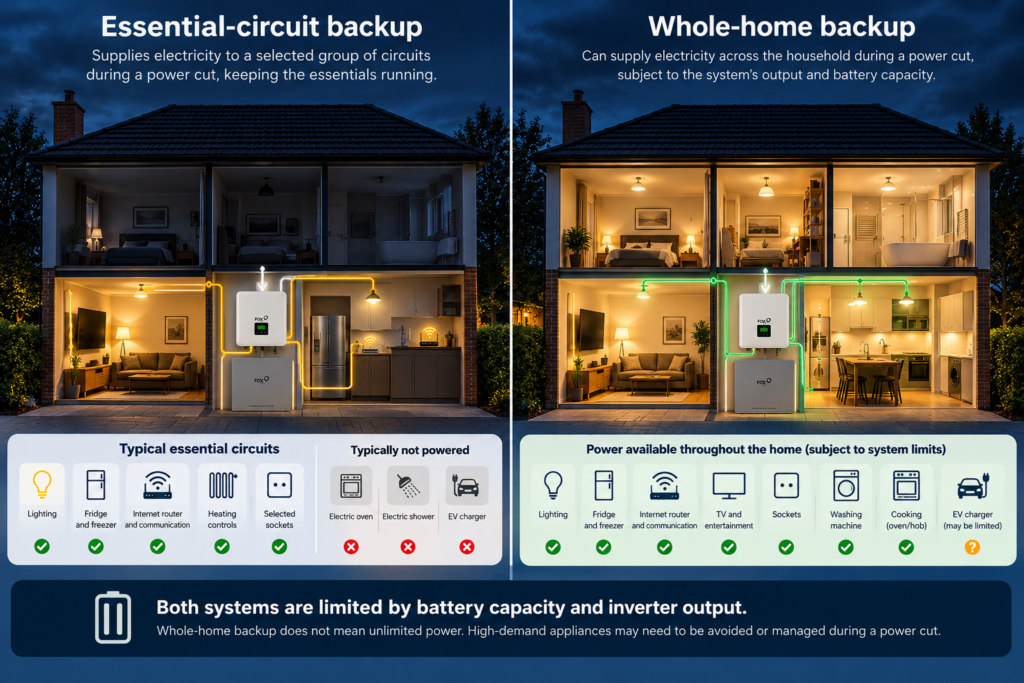
| Feature | Essential-Circuit Backup | Whole-Home Backup |
|---|---|---|
| Circuits supplied | Selected essential circuits | Wider household installation |
| Electrical coverage | Limited to designated circuits | Potentially available throughout the property |
| Battery consumption | Can be easier to control | Depends heavily on household usage |
| High-demand appliances | Usually excluded | May require restrictions or load management |
| Installation requirements | May require dedicated backed-up circuits | Requires suitable whole-home switching and system design |
| Backup duration | Depends on loads and usable capacity | Depends on loads and usable capacity |
| Best suited to | Prioritising essential equipment | Greater flexibility during outages |
Neither approach is automatically better.
A carefully designed essential-circuit system may provide longer practical backup for a household focused on basic services.
A whole-home system may offer greater convenience and flexibility, provided the available backup power is sufficient for the intended loads.
How Much Battery Storage Do You Need?
Battery capacity plays a major role in determining how long emergency power will remain available.
Battery storage capacity is generally measured in kilowatt-hours (kWh).
The higher the usable capacity, the more electrical energy the system can store.
However, battery capacity and inverter output are different measurements.
Battery capacity (kWh) indicates how much energy is available.
Inverter output (kW) indicates how much electrical power the system can deliver at a particular moment.
Both must be considered when designing a backup installation.
An Example of Battery Runtime
Imagine a household has a battery with 10 kWh of usable stored energy.
If the household’s average electrical demand during an outage is 500 watts (0.5 kW), the theoretical runtime would be:
10 kWh ÷ 0.5 kW = 20 hours.
If average demand increases to 2 kW, the theoretical runtime falls to:
10 kWh ÷ 2 kW = 5 hours.
These figures are simplified examples. Actual runtime will depend on inverter losses, standby consumption, battery operating limits, the available charge when the outage begins and changing electrical demand.
This demonstrates why managing electricity consumption is particularly important during a prolonged power cut.
A larger battery may increase the available backup duration, but it cannot overcome an inverter’s maximum output limitations.
Can Solar Panels Extend Battery Backup Duration?
Potentially, yes.
Some compatible solar and battery storage systems can continue generating electricity during a grid outage, allowing solar energy to support household loads and recharge the battery.
However, this capability is not universal.
It depends on the inverter, system configuration, available sunlight and whether the installation supports solar generation while operating independently of the grid.
A standard grid-connected solar PV system should not be assumed to continue generating usable electricity during a power cut.
For homeowners without solar panels, certain AC-coupled battery systems can charge from the grid during normal operation.
These systems may also support emergency backup when installed with compatible equipment.
However, a battery-only system that relies on grid charging will generally have no means of replenishing its stored energy during a prolonged grid outage.
Does Battery Backup Provide Uninterrupted Electricity?
Not always.
Many domestic battery backup systems have a short changeover period between the loss of grid electricity and the activation of the backup supply.
During this interval, some appliances may switch off or restart.
For example, the Fox ESS EPS-BOX-SP has a typical transfer time of approximately two to three seconds.
This is different from a dedicated uninterruptible power supply (UPS), which is designed to maintain power to connected equipment during supply interruptions, with performance depending on the UPS type.
Where uninterrupted electricity is essential, such as for sensitive computer equipment or specialist devices, additional protection may be required.
Households relying on electrically powered medical equipment should obtain appropriate specialist advice and should not assume that a standard domestic battery backup installation provides a medically suitable emergency supply.
What Affects the Cost of Battery Backup?
The cost of a domestic battery backup installation depends on several factors.
These include:
- Battery capacity: Larger storage systems generally require more battery modules.
- Inverter specification: Higher output requirements may influence the equipment needed.
- Backup configuration: Essential-circuit and whole-home arrangements may require different switching and distribution equipment.
- Existing electrical installation: Consumer unit alterations, cabling and protective devices may be necessary.
- Solar integration: Connecting an existing or proposed solar PV system can affect the design.
- Installation complexity: Equipment location, cable routes and site-specific electrical requirements can influence labour and materials.
For these reasons, the most suitable solution and its cost should be established through an assessment of the individual property.
Which Battery Backup System Is Right for Your Home?
Before choosing a backup system, it’s worth considering what you actually want to achieve.
Ask yourself:
1. Which appliances are most important during a power cut?
Would you be satisfied with lighting, refrigeration and internet access, or would you prefer electricity to remain available across more of your home?
2. How long would you like backup power to last?
A system intended to cover short interruptions may have very different storage requirements from one intended to support essential loads for an extended period.
3. How much electricity do you normally use?
Understanding your household’s electrical demand helps determine the appropriate inverter output and battery capacity.
4. Do you have solar panels?
Existing or planned solar PV may influence which battery and backup arrangements are suitable.
5. Are you also interested in reducing electricity costs?
Some battery systems can charge during cheaper off-peak tariff periods and use that electricity later, providing an additional benefit beyond emergency preparedness.
The answers will help establish whether essential-circuit backup or a whole-home configuration is more appropriate.
Considering Battery Backup for Your Home?
Battery storage can offer households greater flexibility over electricity usage and, when designed with suitable emergency backup functionality, additional resilience during power cuts.
Whether you’re interested in keeping essential equipment operating or exploring a whole-home backup solution, the right system depends on your property’s electrical installation, energy requirements and priorities.
Starkey Electrical can discuss your requirements and explore potential battery storage and backup options, subject to a technical assessment of the property and confirmation of suitable equipment and installation arrangements.
Contact Starkey Electrical to discuss your home battery storage requirements and find out which backup options may be suitable for your property.
For a general introduction to emergency battery storage, read our previous article: Can a Home Battery Keep Your House Running During a Power Cut?