
Power cuts can happen unexpectedly, leaving households without lighting, heating controls, internet access and essential electrical appliances. While most interruptions to the UK’s electricity supply are relatively short, severe weather, infrastructure faults and other emergencies can occasionally cause more prolonged disruption.
Recent government advice encouraging households to prepare for emergencies has brought renewed attention to what happens when essential services are interrupted.
But alongside traditional emergency supplies such as torches, batteries and wind-up radios, there’s another option worth considering: home battery storage with emergency backup functionality.
So, can a home battery keep your house running during a power cut? And do you need solar panels to benefit from one?
Why Is Emergency Power Preparedness Important?
The UK government recommends that households consider how they would manage during an emergency that disrupts essential services for several days.
Its preparedness guidance encourages people to keep useful supplies available, including:
- Battery-powered or wind-up torches and radios.
- Portable power banks for mobile devices.
- Drinking water and non-perishable food.
- Essential medication and other household necessities.
- Important contact information.
Although the UK’s electricity network is generally reliable, localised power cuts can occur because of storms, equipment failures or damage to infrastructure.
For households that rely on electrical equipment for heating, communication, refrigeration or other important functions, even a relatively short interruption can be inconvenient.
This is where a properly designed battery backup system may offer additional resilience.
How Does Home Battery Backup Work?
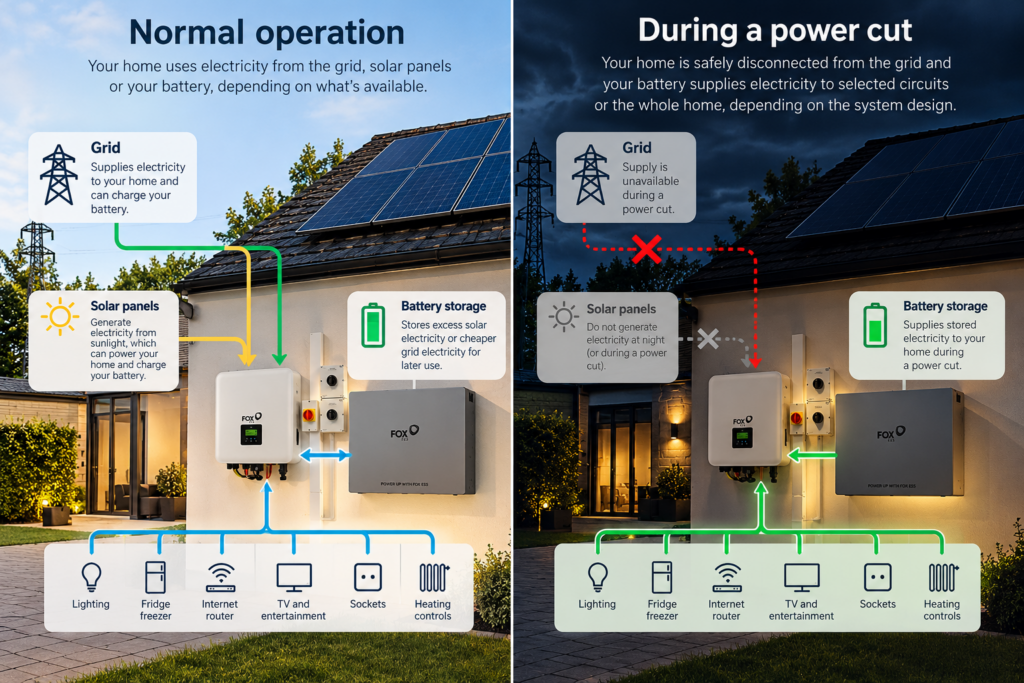
A home battery storage system stores electrical energy so it can be used later.
Under normal circumstances, that electricity might come from solar panels or directly from the electricity grid.
However, not all home battery systems can provide electricity during a power cut.
Many conventional grid-connected systems automatically stop supplying power when the electricity network fails. This is an essential safety measure designed to prevent electricity being fed into the network while engineers may be working to restore the supply.
To provide emergency power, a battery storage installation requires suitable backup functionality, often referred to as an Emergency Power Supply (EPS).
Depending on the equipment and installation design, this may include a compatible inverter, automatic changeover equipment and electrical arrangements that safely isolate the property from the grid during an outage.
When the electricity supply fails, a correctly configured backup system can switch to stored battery power, allowing designated electrical circuits or, in some installations, the wider household electrical system to continue receiving electricity.
The changeover time varies between systems, and some appliances may briefly lose power.
What Can a Home Battery Power During an Outage?
The answer depends on the battery’s usable storage capacity, the inverter’s output rating and how much electricity the household is consuming.
A system designed to support essential circuits might provide electricity for:
- Selected lighting circuits.
- A fridge or freezer.
- Internet routers and communication equipment.
- Phone and laptop charging.
- Certain heating controls and circulation pumps.
- Other selected low-power appliances.
Some systems can also be designed to provide whole-home backup, rather than supplying only a small number of dedicated circuits.
However, whole-home backup doesn’t necessarily mean every appliance can operate simultaneously.
High-demand equipment such as electric showers, ovens, immersion heaters and EV chargers can place significant demands on a battery-powered system.
A suitably designed installation must account for these loads and may require the homeowner to manage electricity consumption during an outage.
How Long Could a Home Battery Last During a Power Cut?
One of the most common questions about battery backup is whether it could keep a household powered for several days.
There’s no single answer.
Battery runtime depends on:
- The amount of usable energy stored in the battery.
- The household’s electricity consumption.
- Which circuits and appliances are operating.
- The inverter’s efficiency and operating requirements.
- Whether solar generation or another suitable source can recharge the battery.
For example, a battery with 10 kWh of usable stored energy could theoretically supply an average load of 500 watts for approximately 20 hours.
At an average load of 1,000 watts, that duration would fall to approximately 10 hours.
These are simplified illustrations. Actual runtime will be affected by system losses, available battery capacity, reserve settings and changing household demand.
A battery may therefore support essential household functions for an extended period if consumption is carefully managed, but three days of emergency preparedness does not automatically mean three days of battery-powered electricity.
Do You Need Solar Panels to Install Home Battery Storage?
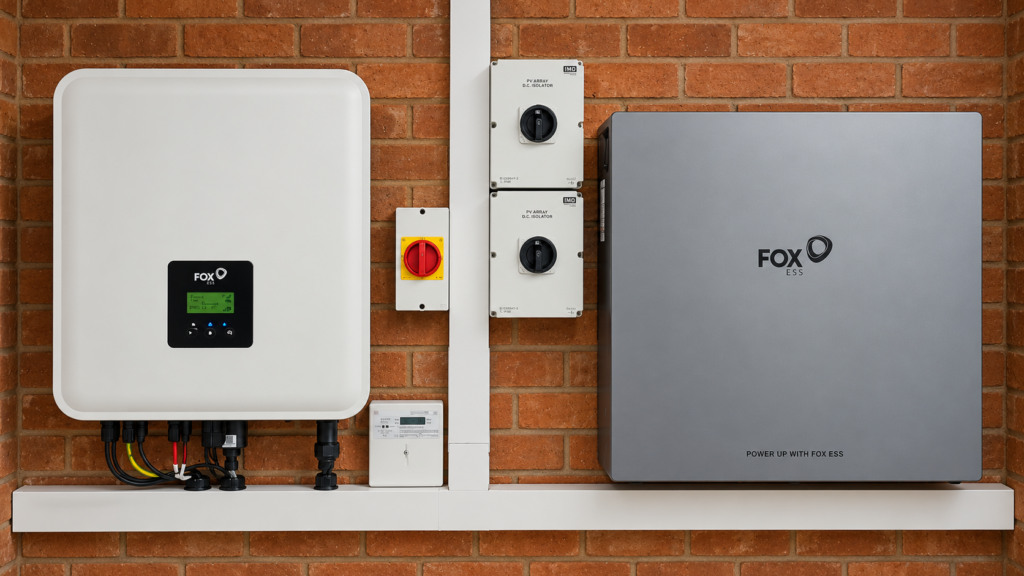
No. Certain home battery storage systems can operate without solar panels.
An AC-coupled battery system can be configured to charge using electricity from the grid, allowing homeowners without solar PV to benefit from energy storage.
This creates two potential advantages.
1. Emergency Backup Power
When paired with compatible backup equipment and installed appropriately, certain AC-coupled systems can supply stored electricity during a grid outage.
The available backup power depends on the specific inverter, battery and installation configuration.
Importantly, a battery-only system that relies on grid charging will not normally be able to recharge from the electricity network while the network is unavailable.
2. Making Use of Cheaper Electricity Tariffs
Some electricity suppliers offer time-of-use tariffs with lower rates during specified off-peak periods, often overnight.
A compatible battery system can charge during those cheaper periods and discharge later when electricity would otherwise cost more.
For example, a homeowner might charge their battery overnight and use the stored energy during the following day or evening.
Potential savings depend on the difference between tariff rates, battery efficiency, electricity consumption and the cost of the installation.
Battery storage doesn’t guarantee lower overall electricity costs, but it can provide households with greater flexibility over when they purchase and use grid electricity.
Essential-Circuit Backup vs Whole-Home Backup
There are two broad approaches to domestic battery backup.
Essential-circuit backup focuses on selected electrical circuits, prioritising equipment such as refrigeration, lighting and communications. This can help extend the available battery runtime by reducing unnecessary consumption.
Whole-home backup uses appropriately rated equipment to supply the household electrical installation during an outage, subject to the system’s available output and any load-management requirements.
The most suitable option depends on the property’s electrical installation, the homeowner’s priorities and the intended backup duration.
We’ll explore the differences between these approaches in more detail in our next article.
Can Battery Storage Replace an Emergency Kit?
No. Battery storage should be considered an additional element of household emergency preparedness rather than a replacement for basic supplies.
Even a well-designed backup system has limitations, including finite battery capacity and possible equipment faults.
Households should still follow government preparedness guidance and keep essential supplies available.
For people who rely on electrically powered medical equipment, backup arrangements require particular care. A domestic battery installation should not be assumed to provide a medically suitable or uninterrupted supply.
Is Home Battery Backup Worth Considering?
For some homeowners, battery storage can offer benefits beyond simply storing excess solar electricity.
A suitable system may provide:
- Greater flexibility over household electricity consumption.
- Opportunities to take advantage of cheaper off-peak tariffs.
- Emergency electricity for selected circuits or wider household loads.
- Reduced reliance on the grid for certain periods.
- The option to integrate with solar PV, depending on system compatibility.
However, the right solution depends on the property, electricity usage, budget and backup requirements.
A household primarily interested in reducing energy bills may need a different system configuration from one prioritising emergency resilience.
Explore Home Battery Storage with Starkey Electrical
Whether you’re considering battery storage to manage electricity costs, exploring options for emergency backup, or thinking about combining storage with solar panels, understanding the available technology is an important first step.
Starkey Electrical provides electrical installation and renewable energy services and can discuss your property’s requirements and the options available.
Interested in home battery storage? Contact Starkey Electrical to discuss your requirements and find out what solutions may be suitable for your property.